Pinion input
Receives driveline rotation and turns the ring gear.
Differential & driveline service · Chicago
The differential transfers power to the drive wheels while allowing them to rotate at different speeds in a turn. When its oil, bearings, gears or seals deteriorate, the sound often changes with speed, throttle or cornering. We isolate that pattern before planning a repair.
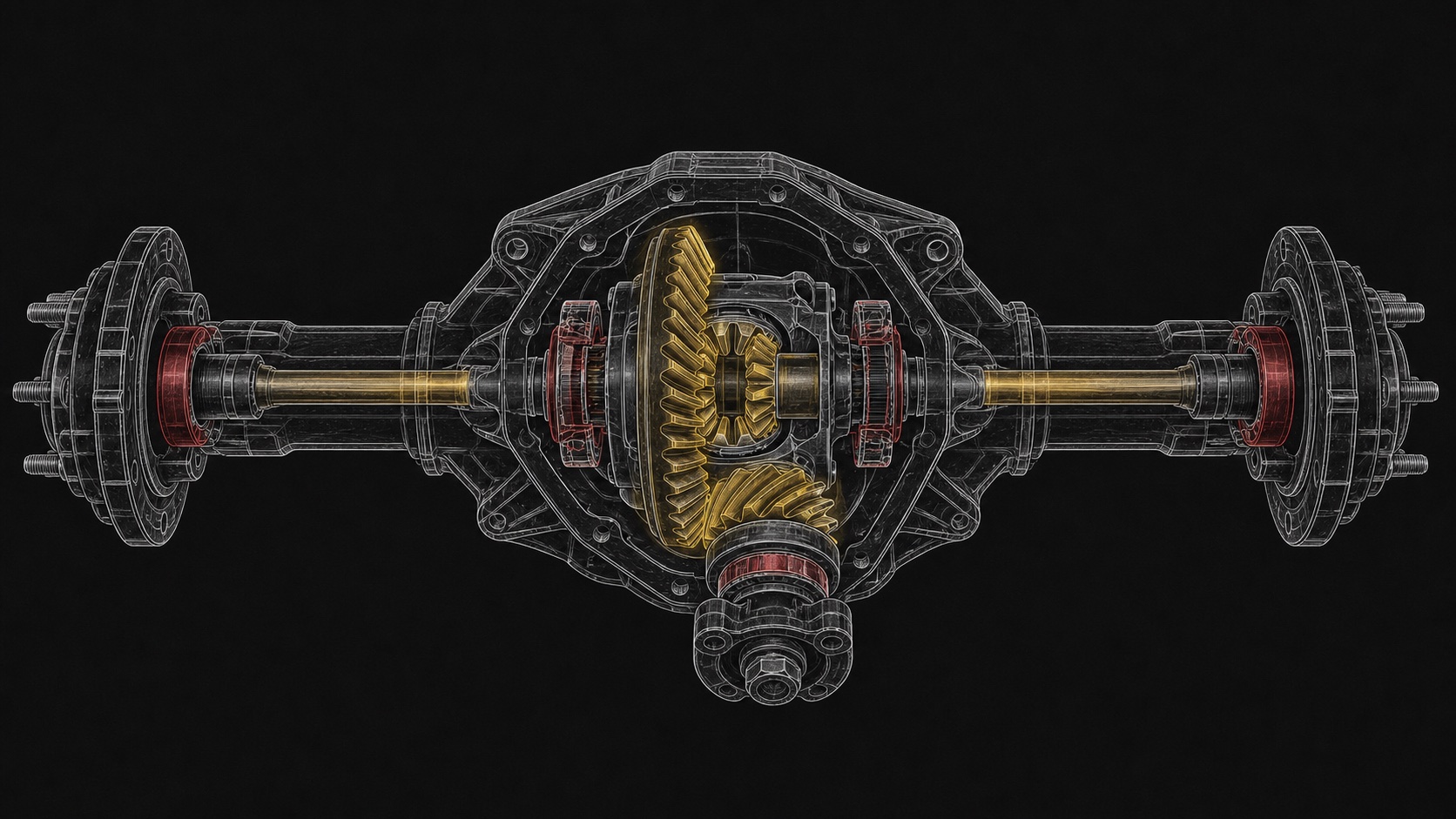
The center gearset divides torque while allowing different wheel speeds.
Receives driveline rotation and turns the ring gear.
Carry torque across the axle centerline.
Allow left and right wheels to rotate at different speeds.
Hold alignment, contain lubricant and control heat.
Gears divide torque between the drive wheels while bearings, precise setup and gear oil keep the assembly quiet and aligned.
One symptom can have several causes. These signs tell us where to begin—not which part to replace.
We compare acceleration, coast, steady speed and turning conditions to narrow down the source.
Leaks, oil condition, axles, joints, bearings and related transmission or transfer-case components are checked.
When internal work is needed, wear patterns, bearing play and gear setup guide the repair plan.
Correct lubricant, sealing and mechanical work are followed by a check for noise, leaks and normal operation.
The strongest information from our original service guides, reorganized into short visual chapters.
In a turn, the outside wheel travels farther than the inside wheel. The differential lets those wheels rotate at different speeds while still receiving engine power. Depending on the vehicle, it may be an open, limited-slip or electronically controlled torque-vectoring design.
Because differential noise can travel through the body, a failing wheel bearing, tire, driveshaft or transfer case can sound similar. Road testing and inspection are important before the differential is opened.
Gear oil lubricates the ring gear, pinion, carrier, side gears and bearings while carrying heat away from their contact surfaces. Low, contaminated or incorrect lubricant can accelerate wear. Some limited-slip units require a specific fluid or additive.
The older site listed differential oil changes, cleaning contaminated oil and gasket resealing. We also evaluate bearings, gear contact, axle seals and related driveline parts so the recommendation addresses the reason for the leak or noise.
Front-wheel-drive vehicles may integrate the differential into a transaxle, while rear-wheel and all-wheel-drive vehicles can have separate front, rear or center units. The location and service procedure depend on the vehicle design.
Bring the year, make, model and drivetrain information if known. Tell us whether the sound changes under throttle, while coasting or during a turn; that detail helps the diagnostic process.
Intervals vary by manufacturer, fluid type and use. Towing, water exposure and severe service can change the requirement, so the owner’s manual and oil condition should guide the interval.
Yes. Tires, wheel bearings, driveshafts, axles and transfer cases can produce similar humming or vibration. Diagnosis should locate the sound before parts are replaced.
Excess play can come from differential gears, mounts, universal joints, axles or other driveline connections. Inspection is needed to identify the exact source.
Yes, multiple drivetrain layouts can be evaluated. AWD vehicles may require checking front, rear and center or transfer components because symptoms can overlap.



Towing available